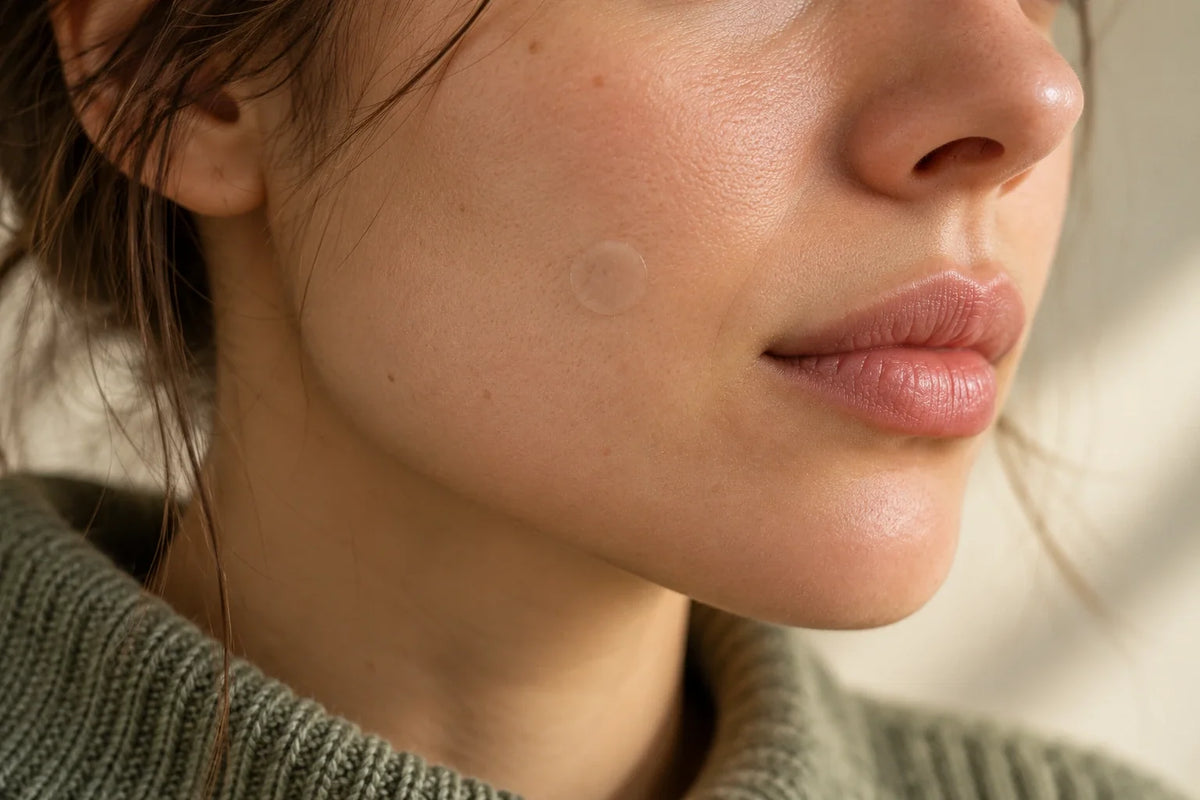
A pimple patch does not dry out a pimple. Quite the opposite: it covers the blemish, absorbs the fluid that comes out of it, and keeps the surface moist. That is why it does not work the same way for every breakout: it can make a visible difference on a pimple with a defined head, but it absorbs almost nothing from a deep, painful bump under the skin.
Knowing when a patch will actually help keeps you from wasting a pack and helps you set realistic expectations. This guide brings together how pimple patches work, which breakouts to use them on, how many hours to leave them on, and how to choose a good one.
Quick Answer
A pimple patch is a small patch made of a material called hydrocolloid, which turns into a gel when it comes into contact with fluid. It absorbs fluid from pimples that have come to a head and sit close to the surface, keeps the pimple in a moist, covered environment, and helps prevent touching and picking. Apply it to clean, dry skin and typically replace it after 6-8 hours. Its effect is limited on deep, painful pimples without a head.
Every part of that answer has a reason behind it. To understand it, you need to start with what the patch is made of.
What Is a Pimple Patch? Are Acne Patches and Pimple Patches the Same Thing?
A pimple patch is a small, usually clear, round hydrocolloid patch applied directly on top of a pimple. Names like acne patch, pimple patch, acne patch, and pimple patch are often used to describe the same type of product. The difference is not the name, but what is inside the patch.
Hydrocolloid is a material made from polymers that form a gel when they come into contact with water. It has been used in wound care for decades. The patchs inner layer absorbs fluid coming from the pimple and turns into a gel, while the outer layer covers the surface against dirt and external irritants. The white, raised area you may see on the patch over time is this gel.
On the market, patches generally fall into three categories: classic patches that contain only hydrocolloid; medicated patches with an added active ingredient such as salicylic acid; and microneedle patches with tiny dissolving tips on the surface. The main focus of this article is classic hydrocolloid patches, the most common type.
What Does a Pimple Patch Do?
A pimple patch does four things, and none of them is drying out a pimple. Its value comes from doing all four at the same time.
- Absorbs fluid: It draws out inflammatory fluid from a pimple that has come to a head and traps it in the gel. This helps the pimple flatten more quickly.
- Creates a moist, covered environment: It helps prevent the surface from scabbing over and cracking. The moist healing principle used in wound care applies here as well.
- Helps prevent touching: It makes it physically harder to pick at or squeeze the pimple. This habit is a common reason for scarring and dark spots.
- Protects from external factors: It reduces contact with dirt, makeup brushes, pillow friction, and sunlight.
A dermatologist at a university hospital in the US explains in a University Hospitals article that the patch draws moisture from the area and also acts as a barrier that keeps someone from picking at their pimple. The least discussed but most effective benefit is likely this second role.
Do Pimple Patches Dry Out Pimples?
No. A pimple patch does not dry out a pimple; it keeps it moist and covered. Although many Turkish-language sources say patches help pimples dry out, hydrocoolloids mechanism is the opposite.
Hydrocolloid wound dressings are designed to absorb fluid while creating a moist environment over the wound. A dermatology review published in 2025 also summarizes that this material forms an absorbent, moisturizing, and protective layer. A pimple that dries out forms a scab; that scab can crack and becomes easy to pick off. In a moist environment, the surface tends to recover more smoothly.
This difference has a practical takeaway. If you are trying to dry out a pimple, you should not apply drying products on top of or under the patch, because the patch works differently. Cream or toner applied under the patch also interferes with adhesion and can prevent the patch from absorbing fluid.
Do Pimple Patches Really Work?
Yes, but with clear limits. The most-cited study on hydrocolloid patches is a small but controlled trial, and its results clearly show what patches can and cannot do.
In a double-blind, randomized pilot study of 20 people with mild to moderate acne, participants used either a hydrocolloid patch or a standard skin bandage every other day for one week. In the hydrocolloid group, acne severity and inflammation decreased significantly more from day 3 to day 7. The same study also measured the UVB reaching the skin under the hydrocolloid patch at 7.4%, compared to 38% under the standard bandage.
More recent data points in the same direction. In a study of 41 people presented as a conference abstract in 2024 in the Journal of the American Academy of Dermatology, the group that added hydrocolloid patches to gentle cleansing reported significant improvements in pimples texture, redness, size, and elevation. However, the full text of this study has not yet been published in a peer-reviewed journal.
These results are encouraging, but they are based on a small number of small studies. The review linked above also emphasizes that there are few clinical studies on pimple patches and that the current evidence is still early. The honest summary: a patch is a helpful support that can aid healing and reduce the risk of marks when used on the right type of pimple, but it does not replace acne treatment.
What Type of Pimple Is a Pimple Patch Good For?
A pimple patch works best on a pimple with a clear head that sits close to the surface. If there is no fluid for the patch to absorb, you will not see it turn white, either. The table below breaks down pimple types by what a patch can realistically do.
| Pimple type | What it looks like | Will the patch help? | What to expect |
|---|---|---|---|
| Pimple with a clear head (pustule) | A raised pimple with a white or yellow dot in the center | Yes, this is where it works best | The patch turns white within a few hours; the pimple flattens |
| Pimple that opened on its own, without bleeding | A pimple with an opened head and a small amount of fluid on the surface | Yes | Absorbs remaining fluid and protects the surface without scabbing |
| Red pimple without a head (papule) | Raised, tender, but with no visible head | Partly | Whitening is limited because there is little fluid to absorb; the main benefit is protection |
| Blackheads and whiteheads (comedones) | Oil and cells trapped in the pore | No | A patch does not unclog pores |
| Deep, painful swelling (nodule, cyst) | A firm, painful, headless bump under the skin | No | There is no surface fluid; a dermatologist evaluation is needed |
| Squeezed, bleeding pimple | An open, bleeding surface | No | The product label says not to apply to open wounds and irritated skin |
Swipe sideways to see the full table
For a deep, painful pimple, the first step is not a patch, but patience. The American Academy of Dermatology recommends not squeezing these pimples, and instead using a clean, warm washcloth as a compress for 10-15 minutes three times a day to help it come closer to the surface. The Academy also notes that once the pimple comes to the surface, you can use a hydrocolloid patch to protect the skin.
When to See a Dermatologist Instead of Using a Pimple Patch
Deep, painful pimples that do not go away for weeks: Nodules and cysts are too deep for a patch to reach and have a high risk of scarring. These pimples should be evaluated by a dermatologist.
Dark spots or indentations left after a pimple heals: The American Academy of Dermatology recommends seeing a dermatologist if you notice dark spots after acne clears.
Spreading redness, worsening pain, warmth, or fever: These can be signs of infection. Stop using the patch and see a physician.
Widespread acne that flares frequently: If you are using many patches every week, the issue is not the patch. It is an acne pattern that needs a treatment plan.
This information is for cosmetic education purposes only and does not replace medical advice.
Outside of these situations, occasional surface-level pimples are where patches shine. The second requirement for good results is how you apply them.
How to Use a Pimple Patch
Apply a pimple patch to clean, dry, product-free skin so it fully covers the pimple. It takes only a few minutes, but each step directly affects adhesion and absorption.
- Cleanse your skin: Wash your face with a gentle facial cleanser. Oil and makeup residue weaken adhesion.
- Dry completely: Pat the area dry with a clean towel. On damp skin, the edges will lift quickly.
- Do not apply product underneath: Do not apply toner, serum, or moisturizer to the spot where the patch will go. You can use them on the rest of your routine around the patch.
- Choose the right size: The patch should fully cover the pimple and the surrounding redness. If the edge lands on top of the pimple, absorption decreases.
- Apply without touching it with your fingers: Lift the patch from the pack by the edge, press down in the center, then smooth outward toward the edges. Pressing for a few seconds improves adhesion with the warmth of your skin.
For most people, applying a patch at the end of an evening routine is the most practical approach. Overnight, you are less likely to touch your face, you are not wearing makeup, and the patch can work uninterrupted.

You can use a patch alongside other acne products, as long as they do not overlap on the same spot. A salicylic acid cleanser, such as Murad Blemish Control Arindirici Temizleme Jeli, is used in the cleansing step and rinsed off. Actives in serum or cream form are applied around the patch. The rule is simple: keep the skin under the patch clean and product-free, and continue the rest of your routine around it.
How Many Hours Should You Leave a Pimple Patch On, and When Should You Replace It?
A pimple patch is typically left on for 6-8 hours and then replaced with a new one. Stick On Spots patch instructions also recommend changing it every 6-8 hours. Since that timeframe aligns with a nights sleep, applying it before bed is a common choice.
The main indicator is the patches appearance. If the patch has clearly turned white and puffed up, its absorption capacity is close to full and it is time to replace it. If it has not turned white but the edges have started to lift, apply a new patch as well. A lifted patch can collect debris and loses the advantage of a sealed environment.
Daytime use is also possible. Thin, clear patches are barely noticeable on the face, and thanks to their waterproof structure, they do not disrupt your day aside from face washing. With daytime wear, the edges may lift sooner due to friction from eating, talking, and masks. For that reason, daytime patches should be checked more frequently.
How many patches you need for one pimple depends on the blemish. A pimple with a clear head often flattens with one or two patches. Once the patch stops turning white, there is no more fluid left to absorb. After that point, applying a new patch only makes sense as a barrier to prevent touching.
Your Pimple Patch Turned White: What Does It Mean, and What If It Does Not?
When a patch turns white, it means the hydrocolloid has absorbed fluid from the pimple and turned into a gel. The white area is not the pus itself, as many people assume; it is the gel layer swollen with fluid. The amount of whitening gives a rough idea of how much fluid has been absorbed.

If the patch does not turn white at all, it does not mean the patch is defective. It means there is no fluid to absorb, in other words, the pimple has not come to the surface yet. This is expected with headless red pimples and deep pimples. In these cases, you can still use a patch to help prevent touching, but you should not expect an absorption effect.
Can You Put a Pimple Patch on a Popped or Squeezed Pimple?
A pimple that opened on its own and is not bleeding is one of the situations where patches work best. It absorbs remaining fluid, helps prevent scabbing, and protects the area from touching.
A pimple that has been squeezed until it bleeds is different. The warning on Stick On Spots product pages says not to apply the patch to open wounds and irritated skin. A bleeding, damaged pimple falls into that category. In this case, wait for the area to recover on its own and avoid trying to squeeze it again.
Squeezing itself is not up for debate. The American Academy of Dermatology states that picking, popping, and squeezing pimples prolongs healing time and increases the risk of scarring and dark spots. One of the most valuable functions of a patch is that it physically stops this habit.
What to Do After Removing a Pimple Patch, and Can It Leave Marks?
Remove the patch by gripping an edge and pulling slowly, parallel to the skin. Pulling quickly and upward can stress the sensitive surface underneath. Then gently cleanse the area with lukewarm water and apply a new patch if needed.
The patch itself does not cause scarring. Scars and dark spots typically come from squeezing or from deep inflammation. For that reason, a patch is a helper that tends to reduce, not increase, the risk of marks. Still, applying and removing patches repeatedly on the same spot throughout the day can be tiring on sensitive skin. The review linked above also recommends being cautious about repeated removal on thin, sensitive skin.
After removing the patch, protect the area from the sun. Post-acne dark spots can become more noticeable with sun exposure. Using a broad-spectrum sunscreen during the day is the simplest way to help prevent spots from lingering. We also explained a basic face routine step by step in our skin care guide for beginners.
Is It OK to Put a Bandage on a Pimple? Hydrocolloid, Medicated, and Microneedle Patches
A standard fabric or plastic bandage is not a substitute for a pimple patch. The adhesive area of these bandages does not absorb fluid, and the gauze pad in the center can dry the pimple out and may stick to the surface. In Chao et als study, the control group used a standard skin bandage, showing that the difference comes down to the material.
Hydrocolloid wound bandages are made from the same material as pimple patches. However, they are usually thicker and larger, are noticeable on the face, and need to be cut to size. Patches designed for pimples are thinner, clear, and come in ready-to-use sizes.
The other two types have different use cases. Medicated patches add an ingredient such as salicylic acid to the hydrocolloid, but the review notes that there is no study showing this addition provides additional benefit. Microneedle patches, on the other hand, target pimples that have not surfaced yet via dissolving tips on the patch surface. Unlike these two types, a classic hydrocolloid patch contains no active ingredients and works only on surface-level pimples.
What Is the Best Pimple Patch? Five Things to Look For
The best pimple patch is the one that fits the size of your pimple and the moment you plan to wear it. There is no single best patch for everyone, but the criteria that separate a good patch from a weak one are clear. The table below summarizes these criteria and how they show up on the label.
| Criteria | Why it matters | What to look for on the label |
|---|---|---|
| Hydrocolloid percentage | Absorption power comes directly from this material | States 100% hydrocolloid |
| Size variety | The patch should fully cover the pimple and surrounding redness | Size listed in millimeters; mixed-size packs |
| Thinness and transparency | Less noticeable for daytime wear; makeup can be applied over it | Clear, thin; suitable under makeup |
| Adhesion | A lifted edge can collect debris and loses the sealed environment | Waterproof barrier; long-wear claims |
| Skin compatibility | Sensitive skin may react to adhesives | Dermatologically tested; hypoallergenic |
Swipe sideways to see the full table
A practical way to choose a size is to measure the pimple (including redness) in the mirror. Roughly, small, pinpoint pimples are fully covered with an 8-10 mm patch, while more obvious pimples with wider redness are fully covered with a 12-14 mm patch. For the back and chest, larger patches that cover a few nearby pimples at once are often more convenient.
Two notes belong with this table. First, colored and patterned patches may be made from the same material as clear patches. It is less about function and more about when you will wear it and personal preference. Second, where a patch is sold does not change what it is made of. No matter which shelf you buy it from, the first things to look for on the label are hydrocolloid percentage and size.
Which Patch for Face, Back, and Mixed Use?
The pimple patch options at Güzellik Burada cover different use scenarios based on the criteria above. According to Stick On Spots product pages, all are 100% hydrocolloid, waterproof, dermatologically tested, and hypoallergenic. The differences are in size and appearance.
For different pimple sizes on the face
Stick On Spots SOS Band Mixy Hydrocolloid Pimple Patch 24 Pcs
- Four sizes in one: 8 mm (6 pcs), 10 mm (7 pcs), 12 mm (7 pcs), 14 mm (4 pcs)
- According to the product page, its clear design can be used day and night, and makeup can be applied over it
- Makes it easier to match the size to your pimple
You can review the size breakdown and usage details on the Mixy product page.
For regular use in one size, the 12 mm SOS Band Original 15 pcs fits the most common pimple size. Because it is clear, it is also not noticeable during the day. For those who prefer colorful and shaped patches, the 20-count SOS Band Fun offers the same material in a more playful look.
For back, chest, and shoulders, small patches are not enough. SOS Band Maxi includes a total of 6 large patches in two sizes: 37x77 mm (2 pcs) and 51x81 mm (4 pcs). For those who get pimples on both face and body, the Maxi and Mixy duo set combines both needs in one pack.

To support the routine around your patch, you can find products for oily and acne-prone skin on the oily and acne-prone skin page. The brands products beyond patches are collected on the Stick On Spots collection page.
Frequently Asked Questions
Questions about pimple patches are usually about safety, makeup, and how often to use them. The answers below fill in points not covered in detail above.
Are pimple patches harmful?
When used correctly, pimple patches are generally well tolerated. Hydrocolloid is a material that has been used in wound care for decades.
In rare cases, you may see redness or itching from the adhesive. If this happens, stop using it. Not applying it to open, bleeding wounds and not repeatedly applying and removing patches on the same spot throughout the day helps minimize risk.
Can you apply makeup over a pimple patch?
You can apply makeup over thin, clear patches. The Stick On Spots Original patch product page also states that makeup can be applied on top.
Foundation or concealer should be tapped gently from the edge of the patch toward the skin. Rubbing over the patch can lift the edges. Makeup should not get under the patch, only on top of it and around it.
Can you reuse a pimple patch?
No. Pimple patches are single-use. Once removed, the adhesive weakens, and the inner surface holds the fluid absorbed from the pimple.
Reapplying the same patch both reduces adhesion and can transfer debris to the area. Use a new, clean patch each time.
How many days does it take for a pimple patch to work?
On a pimple with a clear head, whitening often appears within a few hours. Flattening typically takes one or two patch changes.
In the pilot study, a noticeable difference was measured starting on day 3. A pimple that does not shrink and lasts longer than a week may not be the type a patch can help with; in that case, it is more appropriate to consult a dermatologist.
Can you use a pimple patch every day?
Yes, you can use it daily as long as you have a pimple. Replacing the patch every 6-8 hours on the same spot and cleansing the skin in between is enough.
If you need many patches every day for many pimples, you may be dealing with acne that a patch alone cannot manage. In that case, a consistent routine and a dermatologists evaluation are added alongside the patch, not replaced by it.
Can a pimple patch cause pimples?
A pimple patch itself does not cause acne. However, a patch applied to dirty skin or a patch with lifted edges that collects debris can increase congestion in the area.
Using it only on clean skin, replacing it once edges lift, and never reusing a patch removes this risk. If small new bumps appear after removing the patch, you may have a sensitivity to the adhesive and should stop using it.
Is there a difference between pimple patches sold at a pharmacy vs. on a grocery store shelf?
Where the patch is sold does not determine what it is made of. Most patches sold in pharmacies, beauty stores, or online rely on the same hydrocolloid technology.
When comparing, look for: hydrocolloid percentage, size information, whether it is medicated, and whether it states dermatologically tested. If you want a medicated patch, the ingredient list will include an active such as salicylic acid. A classic patch contains only hydrocolloid.
Can pimple patches be used for kids and teens?
For surface-level pimples commonly seen during adolescence, a pimple patch can be a practical option. For teens who tend to pick at their pimples, preventing touching is a meaningful advantage.
Follow the age and usage warnings on the product packaging. For young children, store patches out of reach since they are small pieces that could be swallowed.
How to Get the Best Results From a Pimple Patch: The Right Pimple, the Right Timing
Whether a pimple patch works depends on what you apply it to. On a surfaced pimple with a clear head, the patch absorbs fluid, keeps the surface moist, and breaks the squeezing habit. On a deep, painful, headless pimple, the most it can do is protect the area.
As a first step, add a patch to the end of your nighttime routine. Apply it to clean, dry skin in a size that fully covers the pimple, then replace it in the morning. Once whitening stops, the patchs job is done. For pimples that last for weeks or leave marks, talk with a dermatologist.
To compare different sizes, colors, and face-body options, you can browse all pimple patch options at Güzellik Burada.