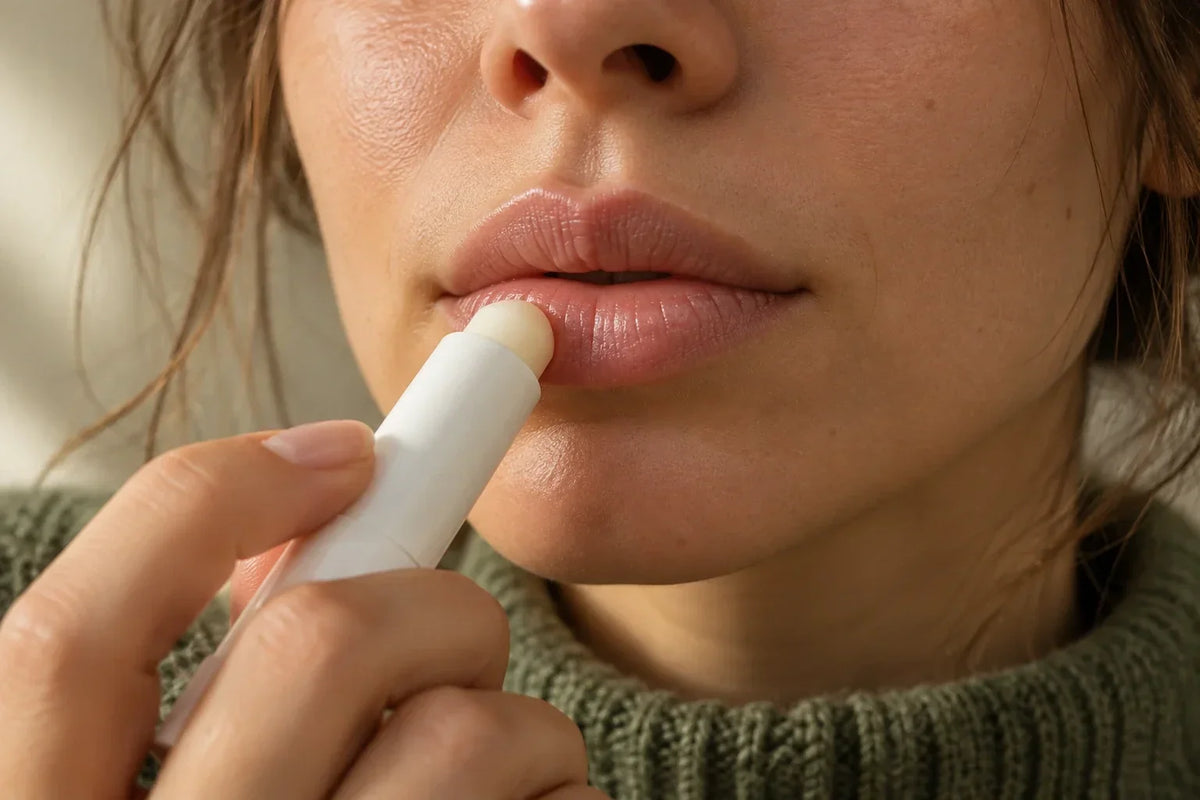
Most guides start lip care with exfoliation. But healthy lips do not need a scrub. There are only two daily essentials: a protective layer that keeps hydration in, and sun protection.
Lip balm, lip oil, a mask, and an exfoliator are added around those two steps based on how your lips feel that day. Knowing what you need and when simplifies your shelf and protects your lips from unnecessary friction and bad DIY advice.
Quick Answer
Lip care comes down to two nonnegotiables: apply a hydrating lip balm during the day and before bed, and use a lip protectant with at least SPF 30 whenever you go outside. Add lip oil for shine, a night cream or mask for intensive care. Use an exfoliator only on lips that feel rough but are not cracked, no more than once or twice a week.
Why these two steps are enough comes down to how lip skin is built differently from facial skin.
Why Do Lips Need Different Care Than Your Face?
Lip skin is thinner than facial skin and has no oil glands. While your cheeks can hold on to hydration with their own oils, lips have no such defense. That is why lips lose hydration much faster in cold, wind, dry indoor air, and sun.
The practical takeaway is clear: the goal of lip care is less about adding hydration and more about slowing water loss. That is why multi-step face routines do not translate one-to-one to lips. What makes the biggest difference is not the number of active ingredients, but how consistently you protect your lips.
We covered the causes of lip dryness and cracking, with measurements, in our lip cracking guide. This article focuses on prevention, meaning the daily care routine for healthy lips.
The Two Core Steps Of Lip Care: A Protective Layer And Sun Protection
The shortest answer to "how do you care for your lips?" is two steps. First, leave a thin protective film on the lips during the day and before bed. Second, when you go outside, that film should include sun filters.
Everything else is added next to these two steps, not instead of them. The table below breaks down lip care product categories by function and necessity.
| Product category | What it does | When | How often | Who does not need it |
|---|---|---|---|---|
| Lip balm (lip protectant) | Leaves a thin film that helps keep hydration on the lips | During the day, after meals, before bed | Whenever lips feel dry | Not unnecessary for anyone |
| Lip protectant with SPF | Adds a filtering layer against sun exposure | Before going outside | Every two hours when outdoors | Anyone staying indoors all day |
| Thick cream or ointment | Creates a long-lasting, thick layer overnight | Before bed | Every night during dry spells | Anyone whose lips are already soft |
| Lip oil | Adds shine and softness, leaves a thin layer | During the day, under lipstick | As desired | Not enough on its own when dryness is noticeable |
| Lip mask | Provides an intensive overnight care layer | A few nights a week | As needed | Not additionally necessary if you already use a thick cream |
| Lip exfoliator | Removes loose, dry skin | On lips that feel rough but are not cracked | No more than 1-2 times a week | On smooth lips and on cracked lips |
Swipe sideways to see the full table
The first two rows are the core steps. The remaining four are options you add or remove depending on how your lips are doing that day. This simple split is the fastest way to see what you truly need when you are looking at the shelf.
What Is Lip Balm, And How Is It Different From Lip Cream Or Ointment?
Lip balm is a lip care product, usually in a stick format, designed to leave a protective layer on the lips that helps keep hydration in. In Turkish, it is also called lip balm, lip protectant, and lip care cream. These names often refer to the same product category.
The difference is not the name, but the texture and packaging. Stick formats are convenient for daytime, while tubes and jars tend to leave a softer, thicker layer. Ointments are the most intensive end of that scale. Thick ointments like petroleum jelly are among the best options for keeping hydration on the lips for the longest time.

Lip balm is also often confused with lip gloss. Lip balm is a care product and does its job even when it is clear. Lip gloss is a makeup product, used primarily for shine and color. Some glosses include moisturizing ingredients, but they do not replace a true protective layer.
To tell whether a lip balm does its job well, it is enough to look at the ingredient groups on the label. These groups determine how the product helps protect hydration on the lips.
What Moisturizes Lips Best? Water-Drawers And Sealers
What moisturizes lips best is using a water-attracting ingredient together with a sealer that helps keep that water on the lips. That is why ingredients in lip care products fall into three functional categories.
- Water-drawers (humectants): Ingredients like glycerin and hyaluronic acid draw water to the lip surface. In dry air, they may not hold on to that hydration for long on their own.
- Sealers (occlusives): Petrolatum (petroleum jelly), beeswax, and certain waxes form a physical layer on the lips. This is the main group that slows evaporation.
- Softeners (emollients): Shea butter, cocoa butter, and plant oils fill in surface roughness. They make lips feel soft and flexible.
A product that contains only humectants may not deliver the results you expect unless it is paired with an occlusive layer. This is even more noticeable in low-humidity environments like heated indoor air. A good lip balm typically includes at least two of these three groups.
Drinking plenty of water is also commonly recommended. Adequate fluid intake matters for overall health, but it does not, by itself, protect lips that are losing hydration to the environment. What protects lip hydration most is the layer that stays on top.
What Does Lip Oil Do, And Can It Replace Lip Balm?
Lip oil is a fluid-texture lip care product that adds shine and softness. Compared to lip balm, it leaves a thinner layer and feels lighter on the lips. That is why it is often preferred under lipstick, on no-makeup days, or whenever you want a glossy look.
However, lip oil cannot always replace lip balm. Thin oils wipe off quickly and do not stay on the lips as long as thicker formulas. When lips are noticeably dry, oil alone is not enough and you need to layer a balm on top, or use a thick cream at night.
On healthy, soft lips, oil can substitute for your daytime protectant. If you are going outside, you still need a separate lip protectant with SPF. Most lip oils do not include sun filters.
Do You Need A Lip Mask, And How Do You Use It?
A lip mask is an intensive care layer designed to stay on the lips overnight. Unlike a face mask, most lip masks are not rinsed off. Apply before bed, and gently wipe away any excess in the morning.
Nighttime is the most efficient time for lip care. Because eating, drinking, and talking do not wear the layer away, the product can stay in place for hours. You do not need a separate mask for this. A thick lip cream in a jar or a simple ointment can do the same job.
That is why application is simple. Apply enough product to clean, dry lips to fully coat them. Do not try to rub it in. Leave it as a visible layer. With jar formats, using a clean finger to scoop product also helps keep the packaging clean.
Is A Lip Exfoliator Necessary, And How Often Should You Use It?
A lip exfoliator is not necessary for healthy, smooth lips. Even though many Turkish guides list it as the first step of care, dermatologists view it as optional. Exfoliation is a solution you reach for when there is loose, dry skin.
New York dermatologist Suzanne Friedler, quoted by Healthline, says healthy lips do not need exfoliation. The same source recommends a gentle exfoliation once or twice a week for people with very dry lips, followed immediately by balm.
The practical meaning is using exfoliation as a fix, not as a habit. Whether it makes sense depends on how your lips look and feel at that moment.
- Rough but intact lips: There is loose, dry skin, but no cracks or bleeding. A gentle exfoliation up to once or twice a week is appropriate.
- Cracked, bleeding, or stinging lips: Do not exfoliate. Abrasive particles can irritate open areas. Focus on a protectant and wait for recovery.
- Smooth, healthy lips: No exfoliation needed. Adding it to your routine exposes lips to unnecessary friction.
If you do exfoliate, keep it gentle. Soften lips first with lukewarm water or a balm applied on top. Using a fine-grain mixture, apply with a fingertip in light circular motions for just a few seconds, without pressing. Then wipe and apply a protectant right away.
A stiff toothbrush, coarse salt, and scrubbing with pressure are too aggressive for lips. If you notice redness, stinging, or sensitivity after exfoliating, the frequency or method is not right for your lips. In that case, pause exfoliation for a while.
At-Home Lip Care: What Works, And Why Lemon Is Not On The List
Not every at-home lip care recipe is equally helpful. A mix of fine sugar with olive oil or honey can be a gentle exfoliation option for rough lips. Petroleum jelly is the simplest at-home alternative to an overnight mask.
Lemon should not be on the list. Lemon, lime, and some citrus fruits contain compounds called furocoumarins. When these compounds combine with sunlight, they can cause a phototoxic reaction in the skin. The medical term is phytophotodermatitis, and the lips are one of the most sun-exposed areas of the face.
A case published in the Canadian Medical Association Journal reported that a 26-year-old woman developed painful redness and large blisters on her hands after squeezing lemon and lime and then staying in the sun. The authors note that severity depends on the amount of the substance and the duration of sun exposure, and that lingering darkening can remain for weeks or even months.
This reaction does not happen with every lemon-based application. Typically, it requires a noticeable amount of juice and strong sunlight together. But there is no meaningful benefit worth the risk. Citrus fragrances are also among the ingredients dermatologists often recommend avoiding on sensitive lips.
DIY lip care cream is another common topic. Mixtures made with beeswax and plant oils can soften lips. But oils in these blends can go rancid over time, and none provide sun protection. So DIY blends do not replace your daytime protectant or SPF.
How To Care For Your Lips During The Day: Morning, Midday, And Night
Daytime lip care is built around three moments. Each takes just seconds, and you will use the same product categories again and again. You can find the overall order of a face routine in our skin care guide for beginners.
- Morning: After cleansing and moisturizer, apply a thin layer of lip balm. If you are going outside, choose an option with SPF. If you will wear lipstick, wait a few minutes for the balm to settle.
- Midday: Reapply the layer that wears off after eating and drinking. On outdoor days, reapply an SPF lip protectant every two hours.
- Night: Remove any makeup residue, then leave a thick layer that fully coats the lips. If you are exfoliating, this is also the best time, because the overnight layer comes right after.
In this routine, what matters is not how many products you own, but your reapplication habit. Instead of licking lips when they feel dry, apply your protectant. This is the single most effective part of the routine. Keeping a protectant within reach in your bag, on your desk, and on your nightstand makes the habit easier.

The structure of the routine stays the same year-round. What changes is how heavily you lean on each step, and season plays a big role in that.
Seasonal Lip Care: What Changes In Winter Vs. Summer
The two core steps of lip care do not change with the seasons, but their emphasis does. In winter, cold and wind outdoors and heating indoors lower humidity. During this time, the overnight layer gets thicker and daytime reapplication becomes more frequent.
In summer, sun protection is the priority. The American Academy of Dermatology reminds that skin cancer can also develop on the lips and recommends using a lip balm or lipstick that contains sunscreen with SPF 30 or higher. In high-reflection environments like the beach, pool, and skiing, a higher-SPF protectant becomes even more important.
Do not drop sun protection in winter either, because snow reflects sunlight and increases exposure to the lips. For a table of which ingredients to choose and which to pause when lips are dry and cracked in winter, see our article what helps with lip cracking.
What Should You Look For On The Label When Choosing A Lip Care Product?
Knowing your need makes label reading much clearer. The table below summarizes five common needs and what to look for on the label.
| Need | Look for on the label | What to watch for |
|---|---|---|
| Daily protection | Occlusives and emollients like beeswax, shea butter, cocoa butter, petrolatum | Formulas that only add shine do not replace a true protective layer |
| A day spent outdoors | SPF value, preferably SPF 30 and higher | SPF 10-15 can be limited for short, in-city use |
| Sensitive or easily irritated lips | A simple formula free of fragrance, flavor, and colorants | Menthol, camphor, and eucalyptus feel cooling, but can irritate sensitive lips |
| Night care | A thick jar cream or an ointment | Stick formats can feel too light for nighttime |
| Prep under lipstick | A lightweight balm or lip oil that absorbs quickly | A thick ointment can make lipstick slip |
Swipe sideways to see the full table
One extra note on cooling ingredients. Menthol, camphor, and eucalyptus can feel refreshing on healthy lips, and many people enjoy that sensation. If you feel stinging or burning when you apply it, that is not a good sign. During that period, switching to a simple formula is a better choice.
Which Lip Care Product Is Right For Which Need?
Güzellik Burada's lip care catalog is built around the two core steps. Most products focus on daytime protection and formulas with SPF. For people who spend long hours outdoors, the standout option is a set that combines both steps in one.
A two-step SPF duo for days spent outdoors
Blistex Ultra SPF50+ and Moisture Routine Lip Care Set
- According to the product page, helps protect lips against UVA and UVB rays with SPF 50+
- The formula contains vitamins C and E
- Recommended to apply at least 30 minutes before sun exposure
You can review what is inside the set and the suggested use on the set page.
For anyone looking for a daytime protectant, there are two paths. If you love a cooling feel, according to the product page, MedPlus Stick contains eucalyptus, menthol, and camphor and offers a refreshing layer for healthy lips. If you want a simpler option without fragrance, artificial flavor, or colorants, Blistex Sensitive, with cocoa butter and shea butter, is a more minimal alternative.
For an overnight layer, a thick jar cream makes things easy. MedPlus Jar 7 ml is a good fit for anyone who wants to leave a visible layer before bed. If you prefer a beeswax-based option, you can go with Burt's Bees Balmumu Lip Care Cream, which also includes sunflower and coconut oil.
For anyone who wants humectant ingredients, according to the product page, Lip Infusions Hydration contains hyaluronic acid plus vitamins E and F and offers a texture that does not feel oily. Lip Revitalizer, with coffee seed oil and peptides, is geared toward those who want a more intensive care feel.
For daily sun protection, there are two levels. For short, in-city use, the vanilla-flavored Classic Lip Protector SPF 10 is an easy starting point. For anyone who wants to meet the dermatologist-recommended SPF 30 threshold, Daily Lip Conditioner SPF 30, with olive oil and grape seed oil, is a better fit.
You can find all of the brand's stick, jar, and SPF options together in the Blistex lip care collection, and beeswax-based formulas in the Burt's Bees collection. Explore daytime-friendly options on the daily lip care page, and value bundles under lip care sets.
Frequently Asked Questions
Questions about lip care are usually centered on at-home methods, smoothness, and daily use. The answers below cover points not discussed in detail in the sections above.
How do you do at-home lip care?
For at-home lip care, a protectant during the day, a thick overnight layer, and a product with SPF when outdoors are enough. If lips feel rough, you can add a gentle exfoliation once or twice a week using fine sugar and oil.
Lemon-based recipes, stiff brushes, and daily exfoliation are not part of this routine. The simplest at-home nighttime option is petroleum jelly or a thick lip cream.
Are lip balm and lip moisturizer the same thing?
In daily use, they usually refer to the same product category. Both are used to leave a layer on the lips that helps keep hydration in.
The difference is more about formula than name. Products that highlight humectants may be marketed as moisturizers, while occlusive-heavy stick formats are often sold as balms or protectants. A good product combines both functions.
What should you do for smooth lips?
The foundation of smoothness is consistent protection. Instead of picking at loose skin, softening it overnight with a thick layer makes it easier to gently wipe away in the morning.
If roughness continues, you can add a gentle exfoliation once or twice a week. Applying a protectant immediately after exfoliating helps keep hydration on the newly exposed surface.
Is it possible to make lips look pinker?
Your natural lip color varies from person to person and is not permanently changed by care products. However, care can help lips look more vibrant, because a dry, flaky surface reflects light more dully.
For anyone who wants a pinker look, tinted lip care products combine care and color. A newly appearing dark spot or a noticeable color change on the lips should be evaluated by a dermatologist, not treated with a care product.
Should men do lip care too?
Yes. No one has oil glands on their lips, and everyone is equally exposed to sun on this area. An SPF lip protectant is especially important for anyone who works outdoors or plays sports outside.
Clear, non-shiny stick formats are easy to adopt for daily use. Fragrance-free options also do not encourage the licking habit that flavored products can make more tempting.
Can petroleum jelly replace a lip mask?
For nighttime care, largely yes. Petroleum jelly is one of the occlusives that keeps hydration on the lips for the longest time, and its fragrance-free profile makes it comfortable for sensitive lips.
Lip masks may also include emollient oils or humectants. If your lips are already healthy, petroleum jelly or a thick lip cream can eliminate the need for a separate mask.
How long can you use a lip care product after opening?
The period-after-opening is listed in months on the open-jar symbol on the packaging. For example, 12M means the product should be used within 12 months after opening.
A product whose scent, color, or texture changes should be discontinued even before that time. Lip products are personal items and should not be shared, especially in contagious situations such as cold sores.
Less, But Consistent Lip Care: Two Core Steps, Three Options
What makes lip care feel complicated is treating every product as equally important. But what lips need every day is simply a protective layer and sun protection. Oil, a mask, and an exfoliator are optional add-ons based on how your lips are doing that day.
As a first step, keep your daytime protectant within reach, and add an SPF option for days you go outside. If lips feel rough, try exfoliating once a week. If they are cracked, skip exfoliation entirely.
To compare stick, jar, SPF, and simple formulas on one page, you can browse Güzellik Burada's all lip care products.