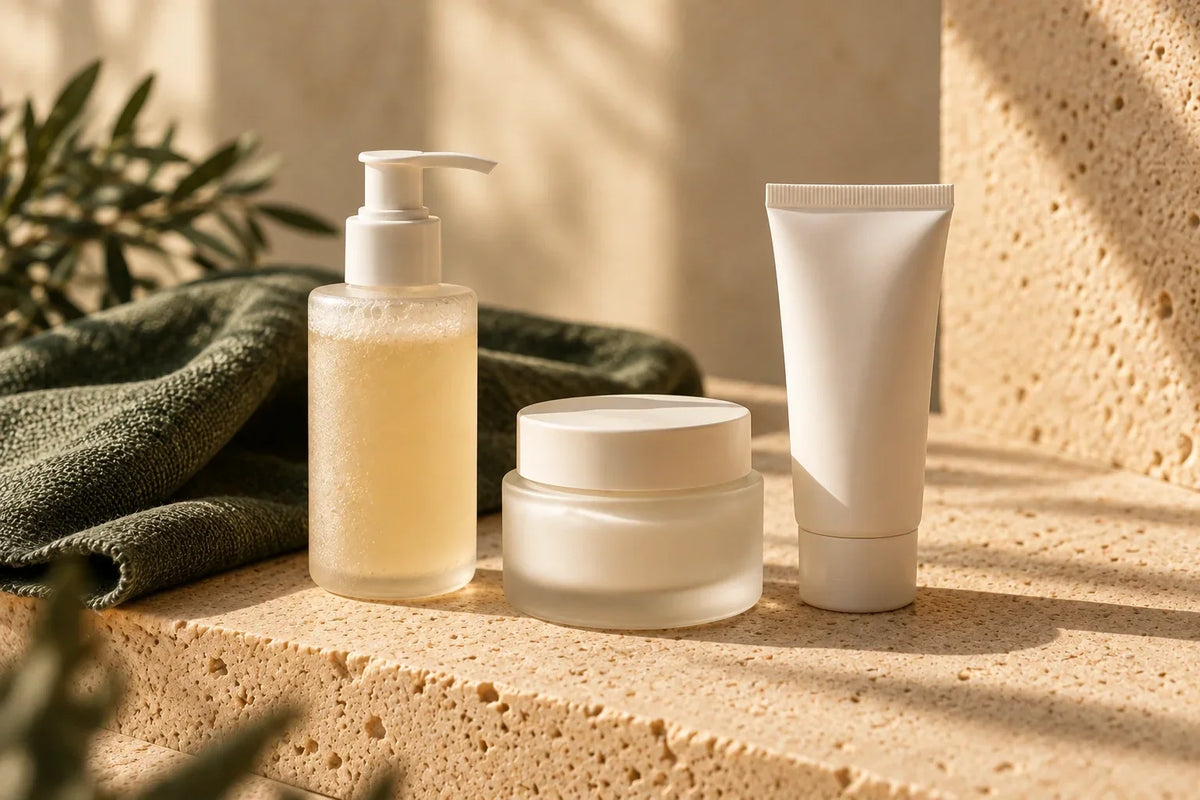
The biggest obstacle for someone new to skin care is not a lack of information, its too many options. Shelves are filled with 10-step routines, and social media is packed with a new must-try product every week. But a good start is not measured by how many items you add to cart.
A starter routine has three products: a gentle facial cleanser, a moisturizer suited to your skin type, and a sunscreen every morning. Once this trio is established, each new product is added one at a time, tested, and with patience. The real test of a routine is whether you can still keep up with it months later.
Quick Answer
Skin care for beginners is three steps: a gentle facial cleanser morning and night, then a moisturizer suited to your skin type, and in the morning, a broad-spectrum sunscreen of at least SPF 30. Toner, serum, exfoliator, and masks are not necessary in a first routine. Add new products one by one, first testing them on a small area.
Each of these three steps looks simple, but choosing correctly starts with knowing your skin. Thats why you should begin with skin type before products.
Where Should You Start With Skin Care, and How Many Products Are Enough?
Three products are enough for a starter routine. A cleanser removes oil, sweat, and buildup that accumulates throughout the day. A moisturizer slows moisture loss and supports the skin barrier. Sunscreen helps protect the skin from the UV rays it is exposed to every day.
The real benefit of starting with three products is being able to read how your skin responds. If you start five new products in the same week, you will not know which one caused a reaction when redness shows up. A simple routine is gentler on the skin and makes it easier to pinpoint the cause if an issue appears.
There is not one single answer to the question, the best skin care product. The best product is the one that suits your skin type and that you enjoy using every day. A pricey or hyped product will not last in your routine if it does not work for your skin.
It is also a smart order financially. When you use the three basics consistently, it becomes much clearer whether a fourth product truly meets a need.
How Can You Tell Your Skin Type?
Your skin type is how your skin behaves when no products are on it. The most practical way to figure it out is a simple observation. Wash your face with a gentle facial cleanser, pat lightly with a towel, and apply nothing for one hour. Then note what you see in the mirror and how your skin feels to the touch.
| What you notice after one hour | Most likely skin type | What to look for in your first products |
|---|---|---|
| Tightness, dull appearance, flaking in some areas | Dry skin | Cream cleanser, rich moisturizer |
| Noticeable shine on the forehead, nose, and chin | Combination skin | Foam or gel cleanser, lightweight moisturizer |
| Shine all over the face, visible pores | Oily skin | Foaming cleanser, gel moisturizer |
| No tightness and no noticeable shine | Normal skin | Gentle gel or foam, medium-texture moisturizer |
| Redness, stinging, or itching | Sensitive skin | Fragrance-free products with simple ingredient lists |
Swipe sideways to see the full table
The last row in the table should be read separately. Sensitivity is often treated like a skin type, but it can show up with dry, oily, or combination skin. So for sensitive skin, product choice comes down to two questions: what is your underlying skin type, and which ingredients irritate it?
Your skin type can also change with the seasons. Indoor heat and cold weather can dry the skin in winter, while that same skin may get oilier in summer. Repeating the test a few times a year, in different seasons, helps keep your routine current.

Dry Skin or Dehydrated Skin?
These are the two concepts beginners mix up most often. Dry skin is a skin type and is related to naturally producing less oil. Dehydration is a condition and happens when the skin loses water.
This distinction has a practical takeaway. Oily skin can also be dehydrated. Skin that looks shiny but feels tight after cleansing is often oily skin where moisturizer has been skipped. That is why skipping moisturizer is one of the most common beginner mistakes for oily skin.
Because dehydration is temporary, it can improve with the right moisturizer and gentle cleansing. Dry skin, on the other hand, is ongoing and requires a routine built with richer products year-round.
Step One: How Do You Choose and Use a Cleanser?
A good cleanser cleans the skin but does not leave it feeling tight. If your face squeaks after washing, the product is also stripping away oils your skin needs for protection. Cream cleansers are usually more comfortable for dry skin, while foam or gel textures are often easier for oily and combination skin.
How you use it matters as much as the product. The basic face-washing rules recommended by dermatologists address the most common beginner mistakes one by one.
The American Academy of Dermatology recommends washing your face with a gentle, alcohol-free, non-abrasive cleanser and lukewarm water, using your fingertips. Gentle motions are advised instead of scrubbing, followed by patting dry with a soft towel. Washing should be limited to twice a day and after sweating.
The most valuable detail here for beginners is using your fingertips instead of a washcloth, sponge, or brush. Scrubbing does not clean the skin; it irritates it. In the morning, one gentle wash is enough. At night, if you wore makeup or sunscreen, cleansing needs a bit more care.
When wearing heavy makeup or water-resistant sunscreen, your nighttime cleanse can be done in two steps. First, use a makeup remover to dissolve products on the surface, then wash with your usual cleanser. On nights after a lighter day, one gentle cleanse is enough. If double cleansing leaves your skin feeling tight, go back to the simpler method.
If you are looking for a daily foaming option for all skin types, Lumene Arctic Aqua Cleansing Foam is categorized on its product page as a daily cleanser suitable for all skin types. For oily and combination skin, Lumene Nordic Clear Purifying Foaming Cleanser with clay offers an alternative that targets excess oil. Other options are available in the cleansing and toner collection.
Step Two: How Do You Choose a Moisturizer?
Moisturizer is the step that slows moisture loss after cleansing. Every skin type needs moisturizer. What changes by skin type is the texture.
Reading ingredients on labels also gets easier, because moisturizers work with three types of components. Knowing them helps you understand why a certain texture suits you.
According to a review examining the role of moisturizers, moisturizers work through three mechanisms. Humectants (glycerin, hyaluronic acid) draw water into the skin, emollients smooth the surface, and occlusives form a thin layer on top to reduce water loss from the skin.
In practice, the ratio of these three components determines the texture. Gel moisturizers are mostly humectant-based and do not feel heavy on oily skin. Creams include more emollients and occlusives, helping hold moisture longer for dry skin. For combination skin, a lightweight cream or gel-cream is usually a balanced starting point.
Timing also affects results. Applying moisturizer right after cleansing, while the skin is still slightly damp, helps occlusive components hold that moisture in. An amount between a pea and a hazelnut is often enough for face and neck.
From our catalog, for example, Lumene Nordic Hydra Hydration Recharge Moisturizer is more comfortable for oily and combination skin thanks to its lightweight texture, while Nordic Hydra Intense Hydration Moisturizer from the same line is easier to use on dry skin. For those looking for a water-based option for sensitive and combination skin, Murad Water Based Nourishing Gel Moisturizer is categorized on its product page as suitable for all skin types.
Step Three: Why Do You Need Sunscreen in Winter, Too?
Sunscreen is the most often postponed step in a routine. Many people see it as a summer and vacation product. But UV rays are present year-round, and they can reach the skin even on a cloudy day.
The American Academy of Dermatology recommends a broad-spectrum (UVA and UVB), water-resistant sunscreen with at least SPF 30. According to the Academy, up to 80 percent of the suns harmful UV rays can pass through clouds. When outdoors, sunscreen needs to be reapplied every two hours, and after sweating or swimming.
What this means for beginners is simple: sunscreen is the last step of your morning routine, and it should not be dropped seasonally. Looking for broad spectrum or UVA and UVB on the label, plus at least SPF 30, solves most of the decision. Do not forget the face, ears, and neck.
Products that combine moisturizer and sunscreen in one step are a practical solution for anyone who wants a shorter morning routine. When applied in a sufficient amount, these products can do the job of two separate products.
For those who want to cut the morning routine down to two steps
Lumene SPF 50 Refreshing Intensive Moisturizer 50 ml
- According to the product page, SPF 50 with UVA and UVB protection
- Moisturizing base with hyaluronic acid
- Lightweight texture categorized for all skin types
You can find the directions for use and ingredient information on the Lumene SPF 50 moisturizer product page.
Sensitive skin often does better with mineral-filter sunscreens. For that option, Murad City Skin Age Defense SPF 50 is one of the mineral-filter products in our catalog. You can compare other options in the sun protection collection.
In What Order Should You Do Your Morning and Night Routines?
The order of products follows a simple rule: go from the lightest texture to the richest. That way, each product can reach the skin without being blocked by the previous layer. Morning routines focus on protection, while nighttime routines focus on cleansing and repair.
| Step | Morning | Night |
|---|---|---|
| Cleansing | Gentle cleanser, or just lukewarm water | Gentle cleanser; if you wear makeup, cleanse makeup first |
| Moisturizing | Moisturizer suited to your skin type | The same moisturizer, or a slightly richer one |
| Protection | Broad-spectrum sunscreen of at least SPF 30 | Not needed |
| Products added later | If used, serum before moisturizer | If used, targeted treatment before moisturizer |
Swipe sideways to see the full table
The last row in the table can stay empty during your first month. Once your routine is running smoothly with three products, any product you add later goes before moisturizer. Sunscreen, in all cases, remains the last step in the morning.
You do not need to wait a long time between steps. Once a product has spread over the skin and the surface is no longer tacky, you can move on to the next one.

Your First Three Products by Skin Type
The table below is a starter recommendation built by skin type using products that are in stock in the Güzellik Burada catalog. The skin type information for each product is taken from the categorization on the product pages.
| Skin type | Cleanser | Moisturizer | Sunscreen |
|---|---|---|---|
| Dry | Lumene Arctic Aqua | Nordic Hydra Intense Hydration Moisturizer | Lumene SPF 50 moisturizer |
| Oily and combination | Lumene Nordic Clear foaming cleanser | Lumene Nordic Clear Balancing Moisturizer | Lumene SPF 50 moisturizer |
| Normal | Lumene Arctic Aqua | Lumene Nordic Hydra Hydration Recharge Moisturizer | Lumene SPF 50 moisturizer |
| Sensitive | Lumene Arctic Aqua | Murad Water Based Nourishing Gel Moisturizer | Murad City Skin SPF 50 mineral |
Swipe sideways to see the full table
This table is a starter framework. For sensitive skin, the most accurate first step is to try each product one at a time with the test described below. If you want to narrow options based on your skins needs, you can browse the dry and dehydrated skin, oily and acne-prone skin, and sensitive skin collections.
How Do You Add a New Product to Your Routine?
Every new product you add is a variable that can change how your skin reacts. Hypoallergenic, natural, or clean-labeled products can still irritate the skin. For that reason, dermatologists recommend patch testing a new product on a small area first.
The American Academy of Dermatology recommends applying the new product in its normal amount to a small, non-rubbed area, such as the inner forearm or the crease of the elbow, twice a day for 7-10 days. If no redness, itching, or swelling occurs during that time, the product can be used.
Turning this test into a beginner calendar keeps your routine both safer and easier to track.
- One product at a time: Do not start two new products in the same week. This is the only way to identify the source if you react.
- Test first, then face: Try the product on a small area for 7-10 days. When testing a rinse-off cleanser, leave it on the skin for a few minutes before rinsing.
- Go slow once you move to the face: After a clear test, start using the product on your full face and observe your skin during the first weeks.
- Wait before adding the next product: Move on only after one product has settled into your routine and your skin stays calm.
This slower pace can feel impatient, but it is actually the fastest path. Most beginners quit early because they try too many products at once.
When Do You Need Toner, Serum, Exfoliator, and Masks?
These products are not part of a starter routine. Toner is not considered a required step. A hydrating, alcohol-free toner can be added optionally, but it does not replace cleansing or moisturizing.
A serum is a product with active ingredients aimed at a specific concern. Before adding one, the need has to be clear: anti-dark spot, fine lines, or dehydration, for example. An active serum added before the basic routine is established adds irritation risk more than it solves problems. The American Academy of Dermatology also notes that most skin care products need at least six weeks to deliver results.
Exfoliators and masks are weekly, optional steps. Especially with beginners, abrasive exfoliators can stress the barrier. Skipping these during the first month gives the skin time to adapt to the basics.
When it is time to move into actives, each one has its own beginner schedule. For example, our guide on how to start retinol walks through the first eight weeks step by step.
What Should You Expect in the First 30 Days?
The first two weeks are the habit-building phase. During this time, the most noticeable change is often how your skin feels: less tightness after cleansing and an overall more comfortable feel.
In weeks three and four, the effect of moisturizer becomes more visible. You may notice smoother skin and a more balanced texture. For expectations like dark spots or fine lines, this timeframe is short.
The most reliable way to track change is photos. A few weekly photos taken without makeup, in the same lighting and from the same angle, can show changes your eyes may miss as they adjust over time.
The most helpful thing to do at the end of the first month is to evaluate your routine. Which products feel problem-free, which step is hard to stick with, and what needs are still not being met? Your answers will determine the fourth product to add.
The Most Common Beginner Mistakes
Most beginner mistakes come from well-intentioned overdoing it. The errors below are the most common reasons people quit a routine in the first months.
Cleaning until the skin squeaks weakens the barrier. Harsh cleansers and hot water remove oils your skin needs for protection. The result is often tightness, followed by more oiliness as the skin tries to compensate.
Skipping moisturizer on oily skin makes the problem worse. Dehydrated oily skin can look tight and shiny at the same time. A lightweight gel moisturizer is one of the easiest ways to break that cycle.
Using sunscreen only in summer cuts the most valuable step of your routine in half. UV rays reach the skin in winter and on cloudy days, too. The last step of the morning routine does not change with the season.
Switching products before you can see results resets your routine every time. Most skin care products show their effects over weeks. If you switch after two weeks, you will not see any products real impact.
The common theme behind these mistakes is impatience. Keeping the routine simple gives your skin room to find its balance.
Frequently Asked Questions
The most common questions when building a first routine tend to center on age, the nighttime routine, and choosing a set. The answers below fill in details not covered in the main body of the article.
At what age should you start skin care?
There is no fixed age to start skin care. Gentle cleansing and sunscreen are meaningful habits for everyone starting in the teen years.
For increased oiliness and acne during adolescence, the first step is still the same trio. If acne is widespread, painful, or scarring, you should see a dermatologist instead of experimenting with products.
What should you apply to your face at night?
In a starter routine, the nighttime answer is simple: a moisturizer suited to your skin type on clean skin. A separate night cream is not required.
For dry skin, a slightly richer cream can be preferred at night. Night products with active ingredients are added only after your basic routine is established, one by one.
Toner first, or exfoliator first?
In a beginner routine, neither is required. If you use both, the order is exfoliator, rinse, then toner.
Exfoliation is a weekly step and is not done every day. Toner is applied after cleansing and before moisturizer.
Is it worth buying a skin care set?
A set brings together products from the same line in a compatible way and can be practical for beginners. However, each product in the set should still be tested one by one.
Sets crowded with serum, masks, and exfoliators mean too many products for a first routine. A selection made up of cleanser, moisturizer, and sunscreen is more functional at the start.
If I do not wear makeup, do I still need to cleanse at night?
Yes. Night cleansing removes sweat, oil, and sunscreen residue that builds up throughout the day. Even if you do not wear makeup, if you use sunscreen, you need to wash at night.
With dry and sensitive skin, morning cleansing can be kept lighter. Rinsing with lukewarm water may be enough in the morning for some skin types.
Do you apply sunscreen before or after makeup?
Sunscreen is applied after moisturizer and before makeup. This creates an even layer of protection on the skin.
Waiting a few minutes for the sunscreen to set can also help makeup sit more smoothly. If you need to reapply during the day, spray or powder formats that can be used over makeup are a practical option.
Does skin care really work?
A basic routine does two measurable things well: it helps maintain the skins moisture balance and protects against signs of premature aging caused by the sun. The American Academy of Dermatology also states that regular sunscreen use can help prevent signs of premature aging such as wrinkles and dark spots.
Setting the right expectations is the real answer to this question. Skin care products help skin look healthier and more balanced, but they do not treat a medical skin condition. Results are also typically seen gradually, over weeks.
Is the routine different for mens skin?
The basic routine is the same: cleanser, moisturizer, and sunscreen. Skin type is a more determining factor than gender.
If there is irritation in shaved areas, using a fragrance-free, soothing moisturizer after shaving can help. Aftershaves with alcohol can dry the skin.
The Measure of a Good Start: Few Products, Consistent Hands
The success of a first routine is not measured by how many products you use. If you can use three products every day, in the right order and in the right amount, you have already gotten through the hardest part of skin care.
Next steps are built on that foundation. When your skins needs become clear, each product you add follows the same method: test first, then start on its own, then observe for a few weeks. This approach both protects the skin and helps you see what actually works.
If you have persistent redness, widespread acne, or ongoing itching, the first step is to consult a dermatologist. A skin care routine supports healthy skin; it does not replace treatment for a skin disease.
If you are ready to choose your first three products, you can explore all essential skin care products from cleanser to sunscreen by skin type in Güzellik Burada's skin care collection.